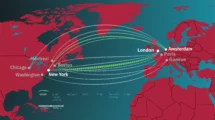



25% of the traffic across the GÉANT network backbone either originates from or is destined for locations outside of Europe, supporting global data-intensive research activities, with an annual growth of 30-35% forecast for GÉANT intercontinental traffic. To meet this growing demand and provide future-proof connectivity solutions, GÉANT is increasingly engaged in mid- to long-term submarine cable investments globally, aligning with the European Union’s own global infrastructure ownership and digital autonomy aspirations.
Starting from the BELLA Programme, GÉANT has become a key implementing partner in the EU’s global infrastructure investment strategy, the Global Gateway. Two flagship digital Global Gateway cable projects – Medusa and Blue-Raman – prove that GÉANT is a vital actor in ensuring strategic intercontinental pathways are in place to connect Europe to the world.
The pathfinder: the BELLA Programme 2016-2022
BELLA – Building the Europe Link to Latin America – changed the routing dependence to Latin America on the United States through a new cable system directly connecting Portugal (Sines) to Brazil (Fortaleza), also connecting Madeira and Cape Verde. The cable system, called EllaLink, cuts the distance between Europe and South America by two thirds and provides Europe with a direct, secure, and high-speed data link to Brazil.
The 5,900 km cable offers around 100 Tbps across four fibre pairs. The initial deployment of BELLA transatlantic spectrum consisted of two 100 Gbps links for use by the European and Latin American R&E networking communities and the EU’s Copernicus Earth Observation Programme, with a total capacity of 8Tbps available for deployment, using current technology. The BELLA Programme also included the BELLA-T (for Terrestrial) project to strengthen RedCLARA’s South American backbone. The combination of the new cable system and a stronger backbone were essential to fully leverage the new capabilities EllaLink brought.
Today, RedCLARA leads the BELLA II project to further strengthen the Latin American and Caribbean digital ecosystems. One of the initiatives is the deployment of testbeds for HPC, blockchain, and cybersecurity, where researchers and institutions can come together in a controlled experimentation space to validate solutions under realistic conditions, minimising risks and costs before large-scale deployment.
The testbeds can be accessed at bella-programme.eu/en/results/testbeds.
In addition to GÉANT and RedCLARA, the BELLA Consortium includes the National Research and Education Networks CEDIA (Ecuador), DFN (Germany), FCT/FCCN (Portugal), GARR (Italy), RedIRIS (Spain), RENATER (France), REUNA (Chile), and RNP (Brazil).
A digital bridge across the Mediterranean: Medusa
GÉANT has been involved in the southern rim of the Mediterranean for over two decades via the EU-funded EUMEDCONNECT and AfricaConnect programmes. To date, however, connectivity from the region into Europe could be secured only through short- term low-capacity leases. This was a very cost-inefficient way of ensuring connectivity, but due to obsolete cable systems and difficult market conditions, there was no alternative to it.
That is where Medusa comes in. As a true gamechanger.
For the first time, a long-term connectivity solution is offered for the North African countries. Especially the €40m EU grant investment into Medusa and the Team Europe approach with the European Investment Bank (EIB) will make all the difference to research as this investment also covers the terrestrial extension of Medusa to interconnect with the national infrastructure – so seamless end-to-end connectivity at high-capacity and upgradable 200Gbps per country. The implementation of the first digital Global Gateway project will accelerate international collaborative research, alleviate the digital divide and stimulate innovation in the process.
The Medusa cable system is planned to be completed in 2026 but remains open to expand to cover future connectivity needs, with appropriate branching units being included in the initial deployment.
Medusa is a cable for an entire generation for North Africa countries. […] It will improve internet performance, lower costs, and create a more resilient regional network that benefits businesses, governments, and educational institutions alike. One of the biggest impacts will be on the NRENs, which will now have long-term, secure, and scalable connectivity to European and global research communities. This is crucial for innovation, collaboration, and economic growth in the region. Norman Albi, Medusa CEO
The Europe-Africa-India digital corridor: Blue-Raman
The Blue-Raman cable system is composed of two cable legs: the Blue cable in the Mediterranean, connecting Italy, France, Greece and Israel with terrestrial routing to the Red Sea Aqaba Digital Hub; and the Raman leg which picks up where Blue left off running, en route to Mumbai, via Saudi Arabia, Djibouti and Oman.
Blue-Raman not only offers scalable terabit capacity, a future-proof spectrum solution with long-term cost control and supply security, but also innovative route diversity and much needed redundancy to make this strategic route from Europe to Asia more resilient – the importance of which cannot be overstated against the backdrop of geopolitical events and dynamics and, recently, frequent cable cuts in the Red Sea.
Global Gateway is supporting the Blue-Raman undersea cable. This cable is a major new data connection that connects India via the Gulf and Djibouti to Europe. Now, together with Italy, we will finance an extension of Blue-Raman from its African hub in Djibouti to Somalia, Kenya and Tanzania. This will connect East Africa to huge digital markets. It is a whole world of new opportunities, for Africa, for Europe and beyond.” Ursula von der Leyen, European Commission President, at The Mattei Plan for Africa and Global Gateway: A common effort with the African continent
The European Investment Bank (EIB) played a central role in structuring the financing of the project mobilising a €23 million contribution from the European Commission. Implemented by Sparkle, Italy’s leading digital submarine infrastructure provider, the initiative brings together key research and education networks.
GÉANT is proud to be part of the Blue-Raman submarine cable initiative. This builds on earlier investments between Europe and Asia: in 2019, GÉANT, together with an international consortium of research and education networks, launched the Collaboration Asia Europe-1 (CAE-1), a 100 Gbps link between Singapore and London. This route provided a more direct connection between Asia and Europe, avoiding the longer path across the Pacific and North America. In 2023, through the GN5-IC1 project, GÉANT added another 100 Gbps link between Europe and Singapore via the AAE-1 cable system, further enhancing resilience and redundancy.
BELLA, Medusa, and Blue-Raman are examples of our commitment to large-scale projects to secure Europe’s connectivity. The Global Gateways are a welcome instrument for us to continue our engagement, so that European research can extend its reach far beyond European borders.
This is the second part of our 20 years of international engagement series. If you would like to read more about GÉANT’s international activities, check out our piece on AfricaConnect!
Read the full online magazine here