



GÉANT’s terabit-ready pan-European network and our services never sleep. Day in, day out, around the clock and all year long, the network ships research and education traffic from one end of Europe to the other and onwards around the world. In addition, our global eduroam service counted 8.4 billion authentications in 2024 alone. It is no wonder, therefore, that our first multistakeholder conference took place even when Belgium had declared a national general strike. Just like our network, the GÉANT community does not stop, we participate, engage and deliver, regardless of challenges.
Around 65 high-level representatives of the European NREN community and of six different Directorate Generals of the European Commission, as well as stakeholders from the EU Member States, University Association and Library communities came together Tuesday to reflect on the GÉANT community’s success stories across the last years and debate what’s next for GÉANT and NRENs in a world with a rapidly changing digital, but also geopolitical, landscape and a new funding cycle coming up in the EU. We were very glad to have this unique opportunity to jointly explore common future interests with both European strategic priorities and the needs of the research ecosystem via the European Research Area (ERA).


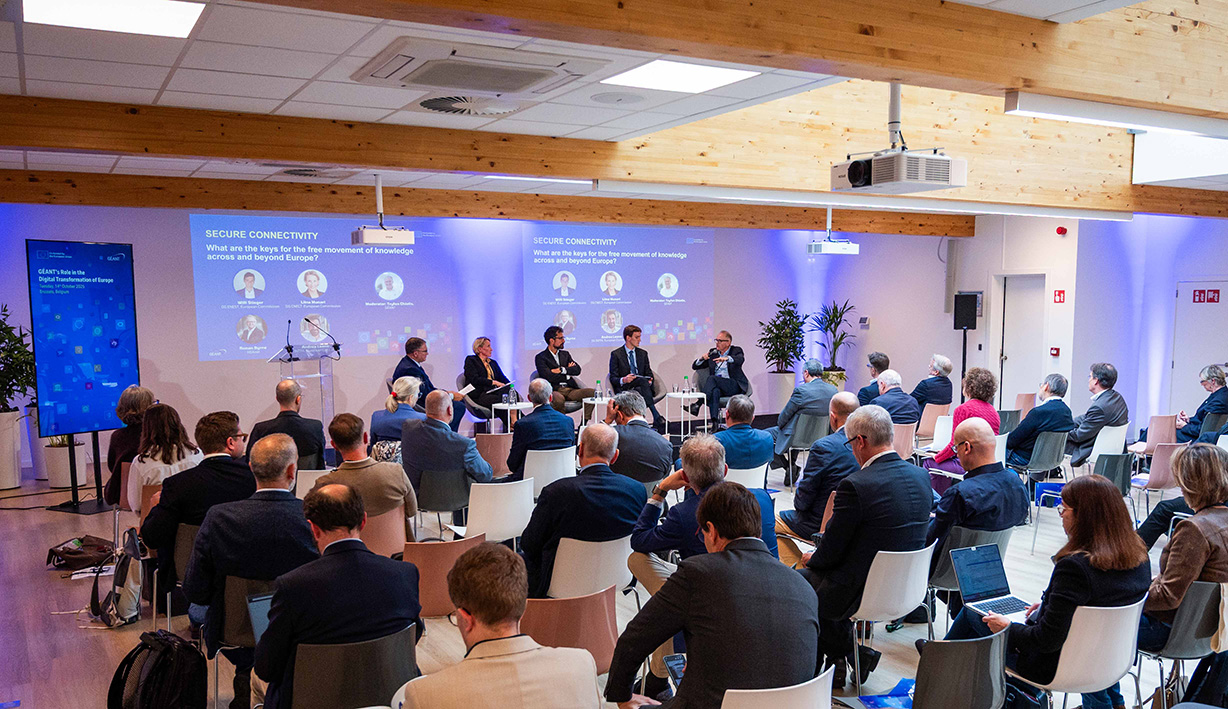
Panel One: Secure Connectivity
Panel Two: Data Access
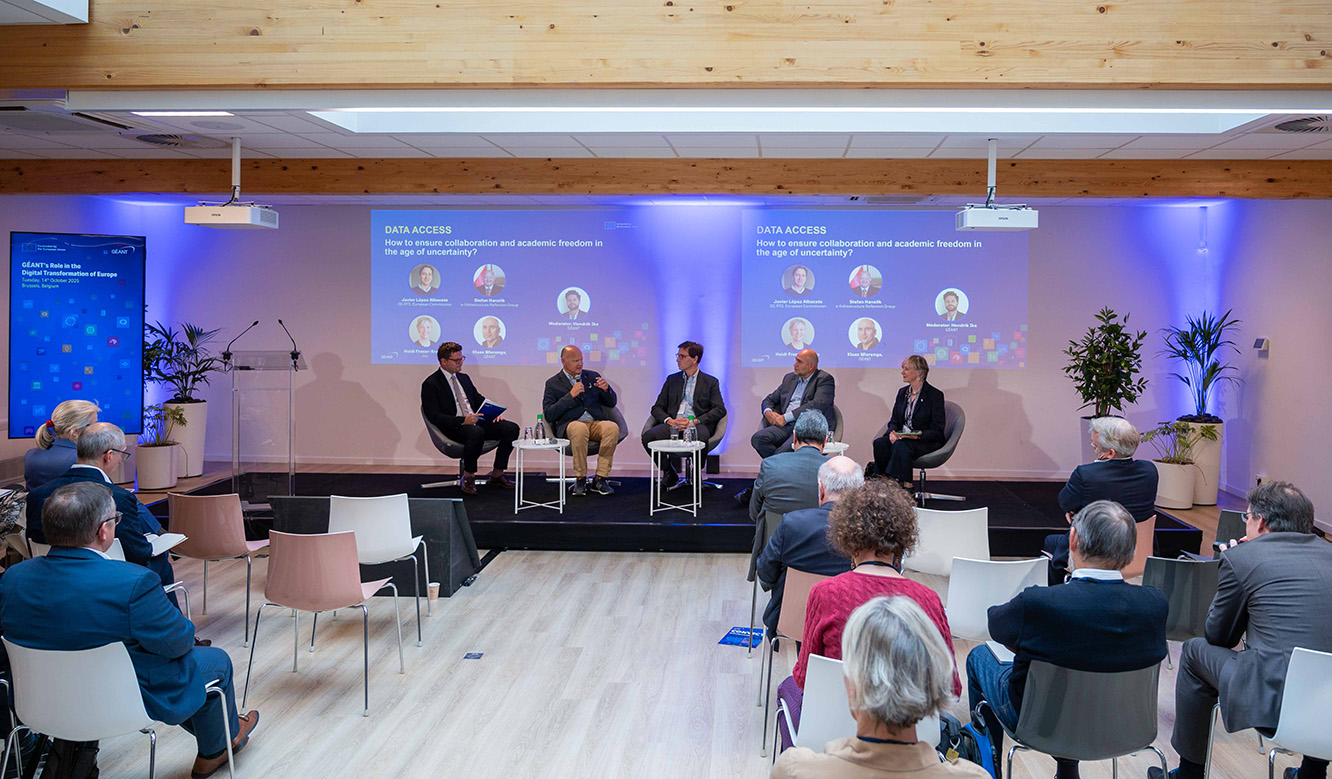
The second panel was chaired by Hendrik Ike, GÉANT’s EU Strategic Partnerships Manager with panellists from the UK NREN, Jisc (on behalf of the GÉANT Board), the Austrian Chair of the e-IRG, DGRTD, as well as Klaas Wierenga, GÉANT’s Chief Services Officer. The panellists covered the topic of Data Access and explored how to ensure collaboration and academic freedom in the age of uncertainty. The balance between data openness and digital sovereignty is at the heart of today’s data debate. The session then addressed how Europe can safeguard academic freedom to foster collaboration while also responding to increasing demands for security, strategic autonomy, and resilience. The panellists explored different dimensions of “access” — to networks, computing, infrastructures, data, and digital identities — and how both GÉANT and policymakers can work together to overcome silos to bridge community cultures, and bring about secure and open environments for research and education.
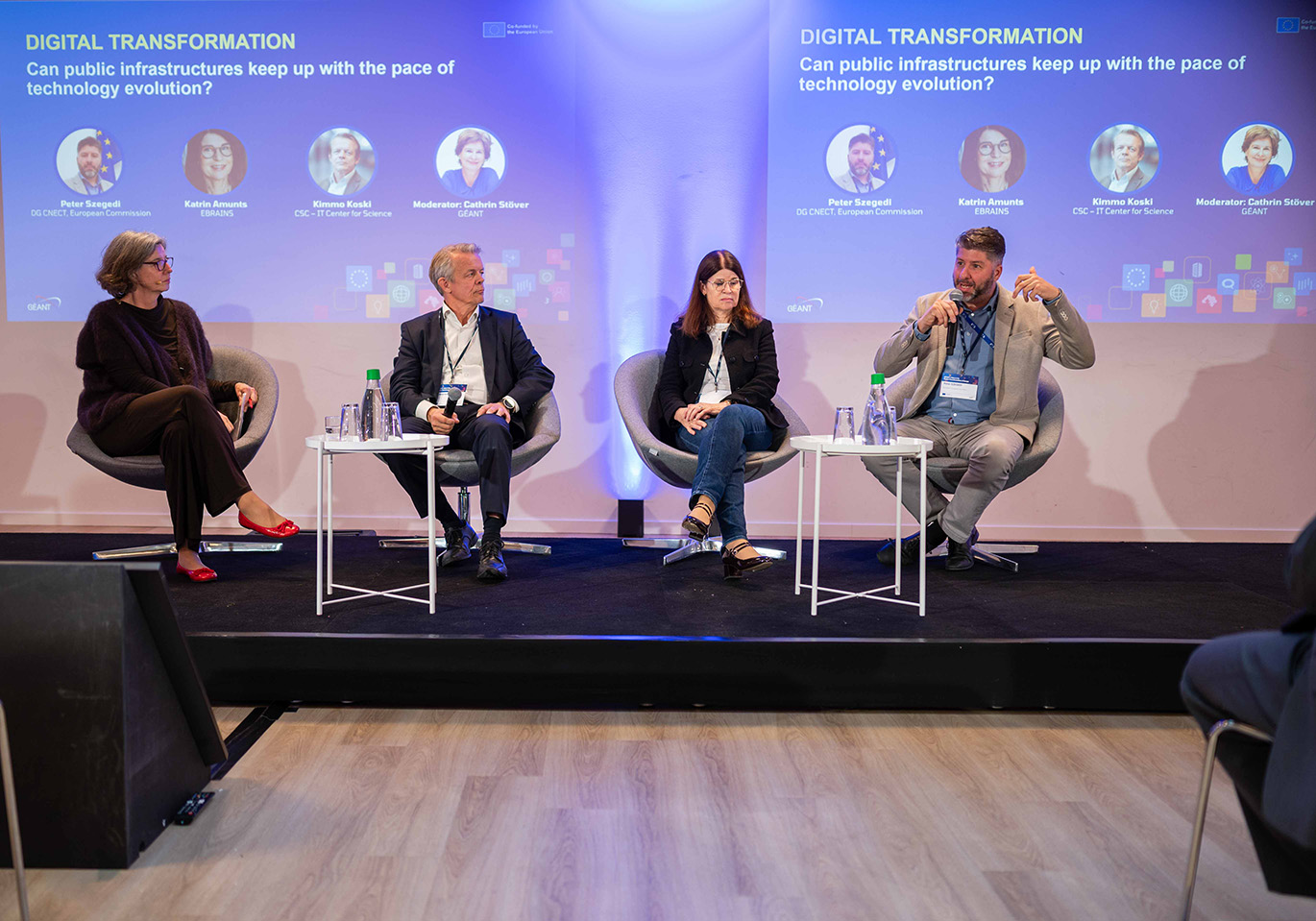
Panel Three: Digital Transformation
A successful foundation for the future
Summarising the active and engaged discussions in the panels, Gilles Massen raised key takeaways from the panels, including the recognition of our secure connectivity work already under way in Europe and beyond via the Global Gateway, the need to not assume that openness and security are mutually exclusive when looking at accessing big data, and to utilise the leverage of our scalable services to aid the digital transformation for research and education. He also noted that as a community, we must work harder to increase our public profile and voice during the ongoing MFF negotiations between the Commission, Parliament and Council.
This event successfully created the foundation for the ongoing conversation between GÉANT, the European NRENs and the Commission institutions towards the securing of our future collaboration for the benefit of research, science and innovation in the ERA.
Lise Fuhr, Chief Executive Officer of GÉANT states: “It was a pleasure to host GÉANT’s first multistakeholder policy event in Brussels this week, bringing the GÉANT community and European policy makers together. Good discussions around the future opportunities and challenges with technology and geopolitics including how we as a community contribute to the competitiveness and resilience of Europe. I look forward to more and continuous conversations, as we align the GÉANT community to the ERA policy goals.”
Background to the event
Three Main Themes
The event was structured around three main themes: Secure Connectivity, Data Access and Digital Transformation. In short: Connectivity. Access. Transformation. These three themes reflect directly on the fundamental policy aims as laid out by Ursula von der Leyen for the current legislative period: A strong and secure Europe; a free and democratic Europe; a prosperous and competitive Europe.
A strong and secure Europe – Secure Connectivity
Secure connectivity is essential for a strong and secure Europe because it underpins the resilience and trustworthiness of the digital infrastructure that supports critical sectors such as healthcare, manufacturing, energy, finance and public administration – to mention some not including our own. By safeguarding networks against cyber threats, hostile interference, and data breaches, Europe can protect its national security, maintain public trust, and ensure the continuity of essential services.
GÉANT and NRENs play a vital role in enabling a strong and secure Europe by enabling public data transfer for R&E, reducing dependence on large global platforms, and providing Europe with options for self-reliant digital capabilities. At the core of this value proposition is a secure and reliable network for the European research and innovation ecosystem.
A free and democratic Europe – Accessing the new data landscape
Enabling data access services contributes to a free and democratic Europe by giving transparency, accountability, and informed decision-making across societies and institutions. By making data – especially public and non-personal data – accessible, individuals, civil society, journalists, and researchers can scrutinise government actions, participate meaningfully in democratic processes, and advocate for policy improvements.
GÉANT and NRENs enable a free Europe by supporting critical research and innovation deployment actions such as EuroHPC and EOSC, especially by underpinning these with democratic, non-discriminatory access to data and computing resources. Leveraging Trust & Identity technologies such as MyAccessID, we maintain a robust federated identity management solution which is increasingly taken up in Europe’s frontline research initiatives.
A prosperous and competitive Europe – our role in the Digital Transformation
The digital transformation helps build a prosperous and competitive Europe by driving innovation, increasing productivity, and enabling new business models across all sectors of the economy. By integrating advanced technologies such as AI, cloud computing, Quantum, 5G, and the Internet of Things, European industries can modernise their operations, reduce costs, and respond more efficiently to global market demands.
Inherent to a community of innovators, the current iteration of the GÉANT (GN5-2) project continues to drive the digital transformation necessary for the EU’s competitiveness and prosperity via the community’s underlying services, access and identity management, and our new above- the-net developments. The needs of the end-users can be pooled and matched, e.g. through OCRE2024. The state-of-the-art network is ready for the increased data traffic expected from integration of data markets and the increased use of AI. Beyond that, Quantum testing on GÉANT’s separate testbed network shows promising potential, while other emerging areas such as Time and Frequency and cable sensing offer exciting tools and alternative paths for network understanding that can be explored.


