

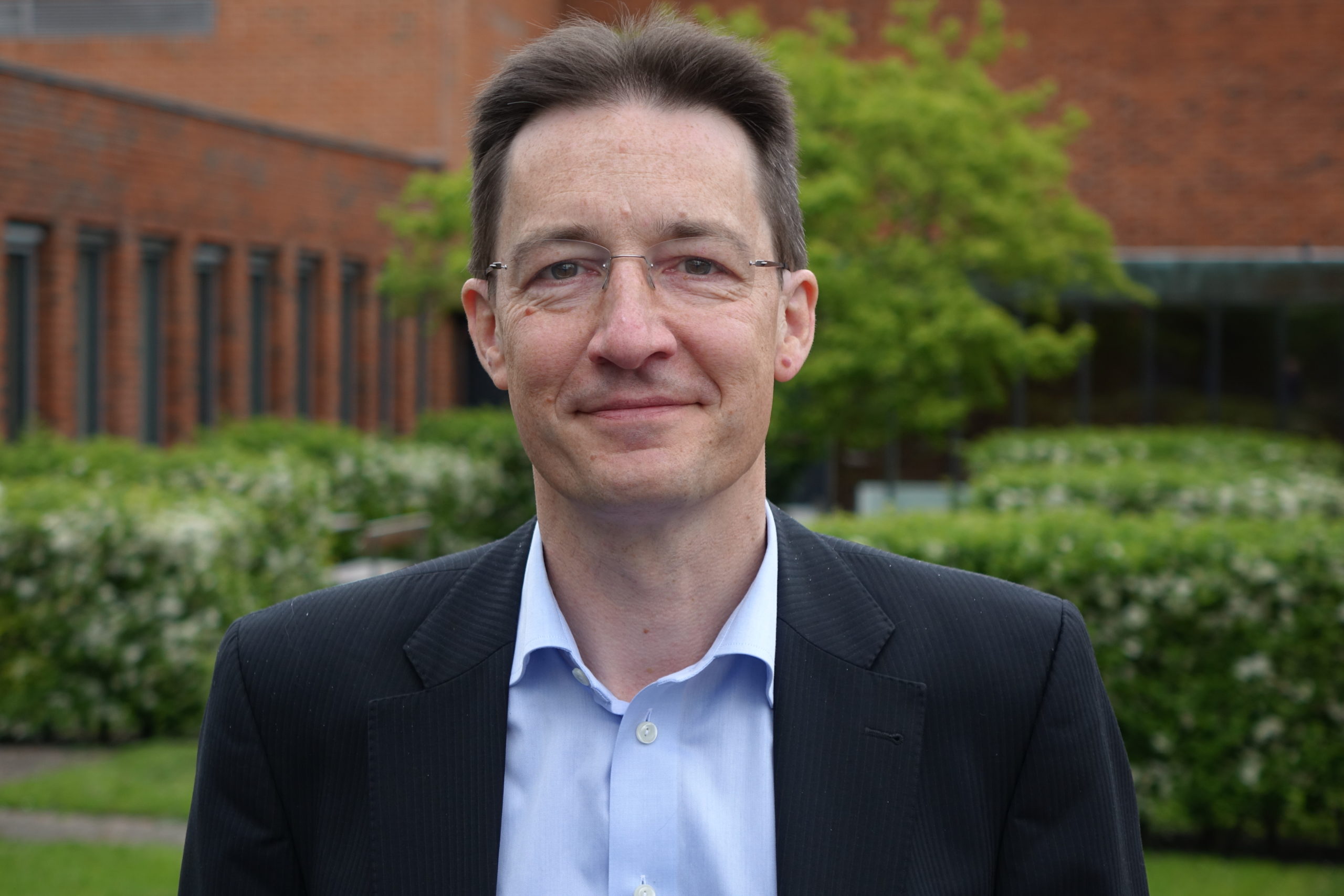

Martin Bech is acting director of DeiC, Denmark’s NREN. Martin and Karl talk about DeiC’s work in a range of quantum initiatives and the role of NRENs in this field.
Martin, thank you for giving us your time today to talk about DeiC’s work in the field of Quantum Technologies. When we met at SIG-Quantum event at CERN in July, we spoke about all of the work that DeiC is doing in the area of quantum. So, tell me what you’re all up to over there and what fascinating things you’re up to.
I would say DeiC’s work has two main two legs here. If you look at the research network itself, then we are involved with, first of all, the national QCI project. And now we are leading a consortium for a cross-border QCI project. This is a three-year project, which started at the beginning of the year, so it’s just we’re just getting going.
This research is funded 50% by the commission under the CEF umbrella. And we have got state funding from the ministry to co-fund that. QCI is the quantum communications infrastructure, QCI. Which is fQCI is on the transportation of keys that are used for encryption.
So, this is very much focusing around the QKD environment, the quantum key distribution environment. That’s really interesting. I was speaking to Guy Roberts from GÉANT recently about this and obviously he’s been very, very heavily involved in QKD and talking a lot about post quantum cryptography, which is a very different area, or is it?
Oh yes I mean, post-quantum cryptography is about finding algorithms that we have not yet figured out how to accelerate by using quantum computing. But such algorithms are designed by humans, so eventually, possibly, they can be broken also by humans. Whereas quantum key distribution relies on a physical principle where you send a few photons that have a specific quantum state. And if that state is preserved to the very end, then you can assume that they have not been tampered with, and therefore no one has listened in. So you can see that no one has, eavesdropped on the. connection and therefore you assume, based on that physical principle, that it is safe. And then you can use this exchange to change keys on classical encryption much faster than you otherwise normally do.
And that’s what really, so maybe those algorithms used for ciphering, deciphering can be broken by quantum computing, but as we accelerate how often we change keys, then it’s still hard because it’s still a finite amount of time which is used even by quantum computing to decrypt or break these algorithms.
So, what are the other aspects of quantum technology that DeiC are involved in?
So, that’s my traditional area. Right now, I’m also acting director of the rest of DeiC and in the rest of DeiC, we have another government grant, which is the implementation of the National Quantum Strategy.
So, what does that entail?
That work that has three legs, The first of which is quantum compute, buying access to quantum computers or quantum computing simulators for researchers, PhD students also, to be able to experiment and develop algorithms and so on. So, we arrange for access to Microsoft, Amazon, IBM, whatever. Some of it, by the way, using the OCRE framework. So, we buy that and we give it for free to researchers that apply for this.
That’s wonderful because obviously the quantum computer computers themselves are so massively capital intensive that being able to buy capacity and time on them is absolutely essential for these early experiments.
Then the second item in that strategy is to sustain or support quantum development and research. into quantum algorithms. And we do that by having programmes where the researchers and PhD students can apply and get funded for their time.
And then the third leg is that we have a number of, summer schools, we call it the Quantum Academy, where again researchers and PhD students can get courses also for free or nearly free, heavily supported.
This is a great initiative because quantum computing it is a very, very different way of thinking and it’s essential that European researchers have the skills to use these technologies. Clearly DeiC is working very hard across the spectrum of Quantum Technologies, do you see any cross-fertilisation with other areas of research?
Yes indeed. Because QKD requires separate fibre infrastructure from normal data traffic we have a potential connection between White Rabbit time distribution and QKD and also with fibre sensing because these technologies can use the same fibre infrastructure. So, to maximise efficiency, we plan to use those same fibres also for White Rabbit and possibly also for sensing, because now we have a section of fibre where we are not using for regular traffic but can use for all these other things that can coexist in the same fibre.
And that’s good because the thing is that at the moment, White Rabbit and other kinds of time distribution have real use cases for society, for research and so on but it is hard to get funding but if we can maximise the usage of infrastructure then these technologies can benefit also alongside the developments in quantum.
This seems to be a fantastic way to get the most of this fibre infrastructure and it’s great to see DeiC being at the forefront of these exciting new opportunities and it must be exciting for you as well to be leading this.
Yes, in so many other areas, we are normally lagging behind because we are a small and poorly funded environment. But in this area, we’ve kind of had the luck that we were prioritised in the national quantum strategy.
Well, you also have the advantage of smallness gives you that flexibility as well to adapt to these fast-moving technologies. Martin, it has been, as ever, been really fascinating, and I really appreciate your time and I look forward to seeing the results of this work over the years ahead, thank you.
Find out more about DeiC’s work in quantum technologies at https://deic.dk/en/quantum-infrastructure