The international conference for High Performance Computing, Networking, Storage and Analysis, better known as Supercomputing (SC), just drew to a close in Chicago on 15-20 November 2026, bringing together researchers, computing centres, network operators, technology providers and industry from across the world.

Now in its 39th edition, SC is one of the world’s largest gatherings dedicated to advanced computing, offering an opportunity to see where scientific computing is heading, from the world’s most powerful supercomputers to experimental quantum processors, optical networks and artificial intelligence.
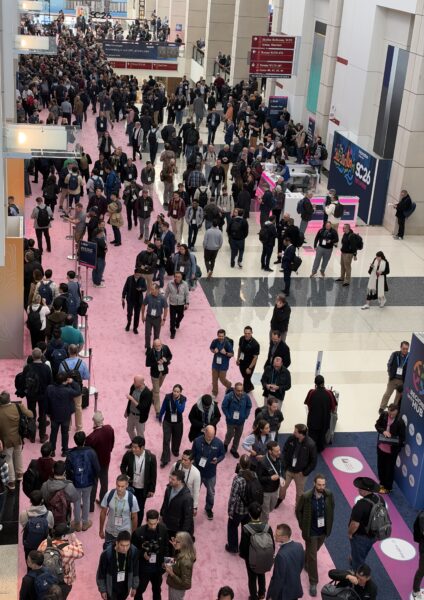
SC26 reported record-breaking attendance of over 24,000 participants and 595 exhibitors from 28 countries. The conference network, SCinet, provided 19.61 Tb/s of wide-area network capacity over 55 connections, approximately 43% more than SC25. Built and operated by an international team of volunteers, SCinet is itself one of the conference’s most impressive technological achievements.
Quantum technologies occupied an increasingly visible part of the exhibition. According to the organisers, 59 exhibitors included quantum technologies among their offerings, compared with just seven at SC22. That is almost one in ten exhibitors.
But perhaps the most interesting observation from SC26 was the growing recognition that the future of quantum technologies depends on how effectively they can work alongside classical computing, networking and AI.
Europe maintains a strong position in global supercomputing
 As usual, SC hosted the announcement of the latest TOP500 and Green500 rankings, measuring respectively the computational performance and energy efficiency of the world’s leading supercomputers.
Europe maintains a substantial presence in both lists. JUPITER, hosted by the Jülich Supercomputing Centre in Germany under the EuroHPC Joint Undertaking, remains Europe’s most powerful supercomputer, ranking fifth globally and delivering one exaflop of measured computing performance. Other European installations include Eni’s HPC7 and HPC6 in Italy, Alps at the Swiss National Supercomputing Centre, LUMI in Finland and Leonardo at CINECA in Italy.
Energy efficiency is becoming equally important as computing centres expand their capabilities. The Green500 measures computational performance per watt, reflecting the growing challenge of increasing computing power while managing energy consumption. European systems occupy the top three positions in the November 2026 ranking, with KAIROS and ROMEO-2025 in France, followed by the Levante GPU extension in Germany.
EuroHPC is also evolving beyond traditional scientific computing. At SC26, CINECA presented IT4LIA, its AI Factory, with plans for more than 8,000 NVIDIA GPUs, a 100 PB AI data platform and high-capacity networking. Meanwhile, LISA, Leonardo’s new AI-optimised partition, entered the TOP500 with 56.88 petaflops, while Alice Recoque, Europe’s second exascale supercomputer, is expected to begin installation in France in 2027.
Quantum needs classical
One recurring message at SC26 was that quantum technologies cannot develop independently of classical computing and communications. Quantum computers need sophisticated classical electronics to prepare quantum states, manipulate qubits, read results and manage errors. More importantly, many proposed applications involve repeated interactions between classical and quantum computation.
A scientific problem may begin with classical data preparation, continue with a quantum algorithm, return to classical computers for analysis and optimisation, and repeat the process. The quantum processor becomes an additional computational resource rather than a replacement for classical computing.
The same applies to quantum communications. Although information is encoded in quantum states, practical quantum networks depend on conventional channels for synchronisation, signalling, authentication and key management. Quantum Key Distribution (QKD), for example, uses quantum signals to establish shared cryptographic keys but requires authenticated classical communication to complete the protocol. In both computing and communications, the challenge is increasingly about integration rather than developing quantum technologies in isolation.
Towards integrated classical–quantum workflows
Hybrid classical–quantum computing was one of the most interesting topics discussed with European and international HPC centres at SC26. The degree of integration varies considerably. At the simplest level, classical and quantum computers operate as separate resources, with users preparing problems, submitting quantum calculations and retrieving results for classical analysis.
More advanced approaches introduce workflow managers coordinating tasks, dependencies and resource allocation. At the closest level of integration, classical and quantum systems interact continuously through feedback loops, with classical processors optimising parameters, analysing measurements or supporting error correction.
AI adds further possibilities, using machine learning to optimise workflows and guide calculations. Quantinuum, for example, is exploring hybrid approaches that coordinate classical and quantum execution, including iterative optimisation and feedback.
In Europe, different EuroHPC computing centres are developing their own solutions. These approaches share a common foundation but are not necessarily interoperable. Centres are developing different extensions to well-known scheduler and resource managers, APIs and orchestration components, without a commonly adopted framework for moving hybrid workflows between infrastructures. A natural next step for GÉANT, through its SIG-Quantum forum would be focusing on promoting interoperability, common interfaces and resource management, as they will become increasingly important.
800 Gb/s across Internet2’s production network
SC26 also hosted several successful advanced networking demonstrations. Ciena and Internet2 established an industry record for the longest terrestrial 800 Gb/s coherent pluggable connection over a live production network. Using Ciena’s WaveLogic 6 Nano technology, the demonstration transmitted data over a 2,104 km round-trip path between the SC26 exhibition floor in Chicago and Internet2’s point of presence in Kansas City, Missouri. The connection operated over Internet2’s production backbone rather than a dedicated laboratory network, demonstrating how next-generation optical technologies can support growing demands from distributed scientific computing and AI.
Quantum-safe communications between Chicago and Bilbao

Another successful demonstration connected Chicago, Amsterdam and Bilbao across approximately 8,000 km, combining quantum and post-quantum security technologies. The international collaboration brought together the University of the Basque Country (EHU), LuxQuanta, Ciena, GÉANT, PCSS, RedIRIS and SURF.
QKD was used over shorter optical links, including a 25 km connection in the Basque Country and a link between exhibition booths at SC26. Longer European and transatlantic connections used IPsec with post-quantum cryptographic key establishment.
The architecture also integrated SURF’s open-source eduKMS with QuLore, demonstrating interoperability between quantum key management systems. Ciena’s optical infrastructure supported quantum and classical signals over shared fibre, with White Rabbit providing precision timing alongside conventional data channels. To the users, it looked and behaved like an ordinary video call between Chicago and Bilbao. Underneath, however, a complex architecture combined QKD, post-quantum cryptography, optical transport, key management and international networking infrastructure.
The demonstration did not distribute quantum states across the Atlantic. Instead, it showed how different quantum-safe technologies can be integrated into a common communications service spanning two continents.
AI Co-Scientists: a changing role for AI in scientific discovery
Artificial intelligence was present throughout SC26, from specialised accelerators to scientific simulation, data analysis and digital twins. One particularly interesting discussion, at the AMD booth, concerned the emergence of AI Co-Scientists. The idea goes beyond analysing experimental data or summarising scientific literature. AI systems are increasingly being designed to participate in the research process itself: generating hypotheses, challenging assumptions, comparing explanations, proposing experiments and refining conclusions through repeated evaluation.
An important development is the possibility of constructing scientific workflows involving specialised AI agents, each with defined tasks, parameters, constraints and success criteria. For AI to become a credible scientific assistant, traceability and reproducibility are essential. Researchers need to understand which models and data were used, how decisions were reached and whether conclusions can be independently verified.
AI models can be trained on structured representations of scientific data, experimental procedures and computational workflows, rather than natural-language text alone. This could enable more direct interaction with simulations, instruments and digital twins. Experimental verification and human scientific judgement remain essential. Nevertheless, AI may increasingly help scientists decide which questions to investigate, rather than simply processing the results.
A relevant example is Google’s Co-Scientist, described in a recent Nature paper. The system uses multiple AI agents to generate, review and refine scientific hypotheses, with initial experimental validation in cancer drug repurposing, liver fibrosis and antimicrobial resistance.
Making technologies work together
A common challenge that emerged from many conversations at SC is integrating increasingly specialised technologies into coherent, usable infrastructures. Quantum processors are becoming part of HPC environments, quantum-safe communications are being demonstrated across international networks, and AI is taking on new roles in scientific workflows.
At the same time, interoperability, scheduling, monitoring and common interfaces are becoming more important. For GÉANT and the European research and education networking community, SIG-Quantum could provide a useful forum for comparing hybrid HPC-quantum approaches, identifying common interoperability requirements and bringing together NRENs, EuroHPC centres and quantum infrastructure operators.
Quantum computing needs classical computing. Quantum communication relies on classical networks. And AI needs computing infrastructure and rigorous scientific methods to become a trustworthy part of scientific discovery. The next step that, as an international community, we see in front of us is not simply making each technology more powerful, but making them work together.