



GÉANT has been selected as a candidate Node in the European Open Science Cloud (EOSC) Federation, joining the second wave of organisations helping to scale up Europe’s open science ecosystem. This candidacy builds upon GÉANT’s contribution to the delivery of the EOSC EU Node, the first EOSC Node, where GÉANT is providing the Authentication and Authorisation Infrastructure (AAI) layer for the EOSC Federation.
The endorsement comes as part of the latest expansion of the EOSC Federation, with 14 new candidate Nodes approved by the EOSC Tripartite Governance at their latest event hosted by the Cyprus Presidency of the EU Council at the University of Cyprus on 21 April 2026. This milestone reflects continued progress in building a federated, interoperable infrastructure that connects data, services and researchers across national and thematic boundaries.
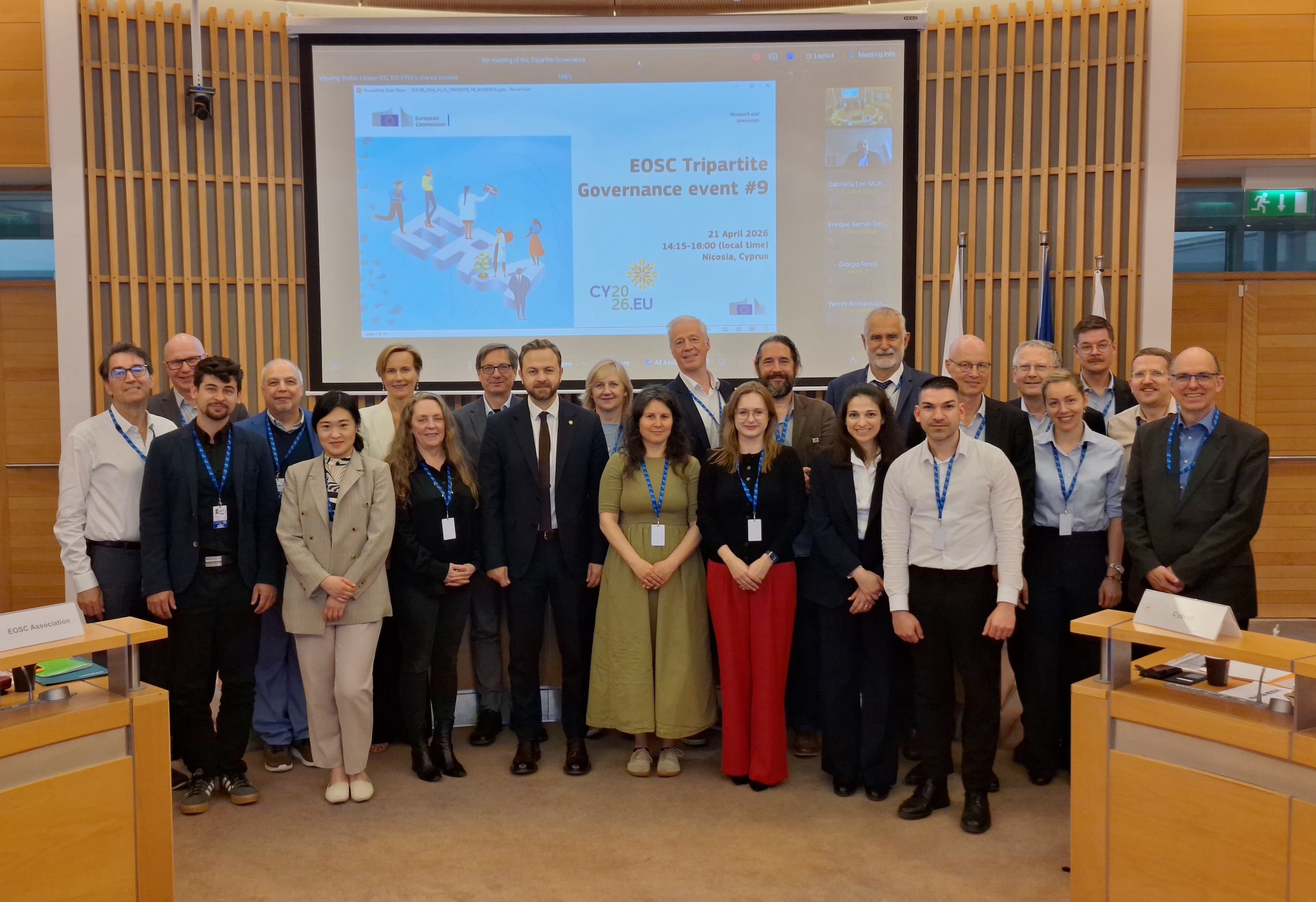
This second wave of candidate Nodes significantly expands the EOSC Federation with national nodes from Czechia, Croatia, Latvia, North Macedonia, Sweden, Slovenia, Switzerland and Türkiye, alongside thematic Nodes in key scientific domains through research infrastructures such as METROFOOD-RI, EBRAINS RI and ENVRI.
GÉANT joins as one of the pan-European e-infrastructure Nodes, alongside EGI and the Scholarly Commons; this reinforces the importance of cross-border digital infrastructure in connecting national and thematic efforts into a truly interoperable European ecosystem.
While different NRENs participate in national initiatives to become a node in the EOSC Federation, the GÉANT Node can act as a gateway to support those NRENs that do not yet participate in the EOSC Federation. It allows NRENs to either onboard their services in the GÉANT Node and become a Resource Provider to the EOSC Federation or equally, the GÉANT Node can redirect requests for services and resources to the NRENs in an on-demand way.
Together, the Nodes strengthen the EOSC Federation’s ability to deliver seamless access to research data and services across Europe. For researchers, this means being able to discover, access and reuse data more easily, without needing to navigate fragmented systems or institutional barriers. It also enables more effective collaboration across countries and disciplines, supported by trusted environments and shared standards.
Joining the EOSC Federation and enabling a common Authentication and Authorisation Infrastructure for Research and Education in Europe marks another step forward in advancing the European Research Area. It adds to the momentum built by a series of landmark milestones, the launch of EOSC EU Node in 2024, the EOSC Federation in 2025 and the EuroHPC Federation Platform in 2026 – all developed with the support of GÉANT and partners – establishing a unified, secure access point to Europe’s research and supercomputing resources.
As a pan-European research and education network and service provider, GÉANT brings long-standing expertise in network connectivity, identity and security. Our participation as a candidate Node will help underpin the Federation with the capabilities researchers rely on in practice, such as trusted and seamless access, secure data exchange and high-performance connectivity, making it easier to move between services and collaborate without technical friction.
GÉANT’s selection highlights our essential role of pan-European e-infrastructures in linking national and thematic initiatives, and underlines our continued commitment to enabling an open, collaborative and data-driven research landscape in Europe.
“Being selected as a candidate Node in the EOSC Federation is an important milestone for GÉANT, as well as our members and for the research and education community we serve. Building on our role in supporting EOSC and the EuroHPC Joint Undertaking, users across research and academia will benefit from simpler, more seamless access to data, services and high-performance computing resources across borders.
As the Federation grows, our role is to make that experience reliable and secure so that users via trusted identities can access resources, collaborate internationally, and work with data without unnecessary technical barriers. We look forward to contributing our expertise to help make open science a practical reality across Europe.”– Lise Fuhr, GÉANT CEO


